
Overview
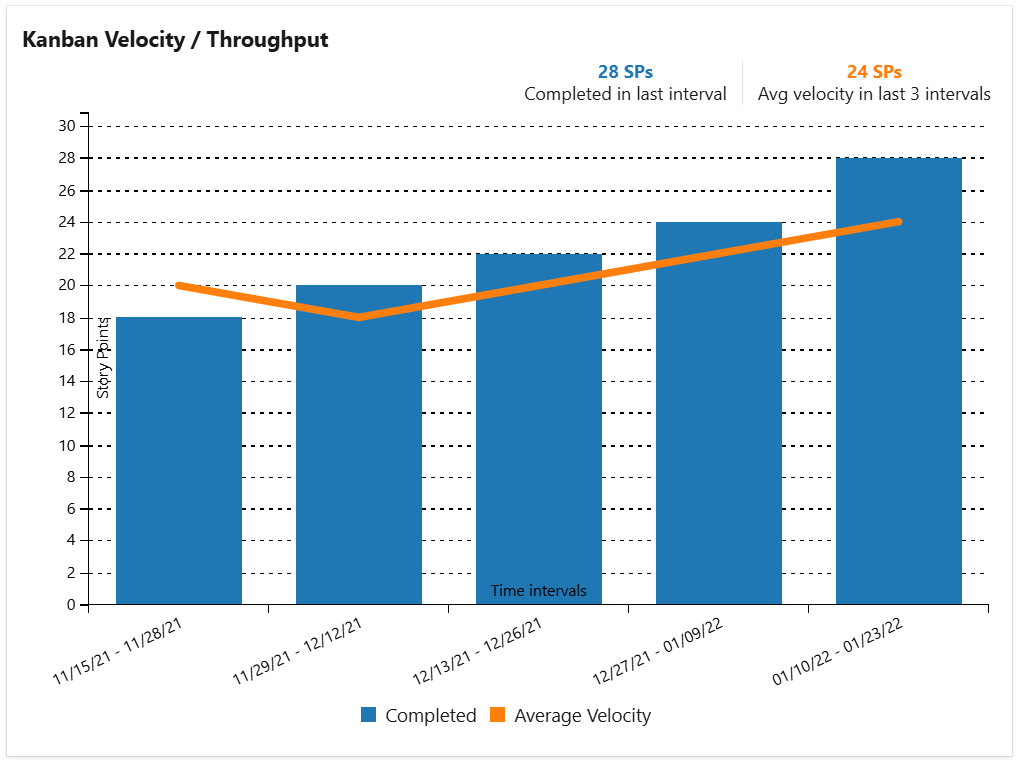
The Kanban Velocity/Throughput widget helps understand the business value your team delivers and to anticipate how much work is likely to get done in the next period.
This widget calculates and displays your team’s current average velocity or throughput based on the work items from selected board or shared query. It uses historical data from each work item and can measure progress by work item count, of the sum of story points, original estimate, or any numerical custom field. This makes it easy to track how much work your team completes over time and plan for upcoming periods.
How does it work?
For each time interval displayed in the chart, the widget counts the completed items in that interval and sums the estimate that each item had at the end of that interval.
The widget shows two key metrics for each time interval:
Done - The total amount of work done in that time interval, calculated in story points, hours or the number of work items according to the widget's settings.
Velocity - The (rolling) average velocity/throughput calculated as the average of work completed on the last time intervals, according to the widget's settings.
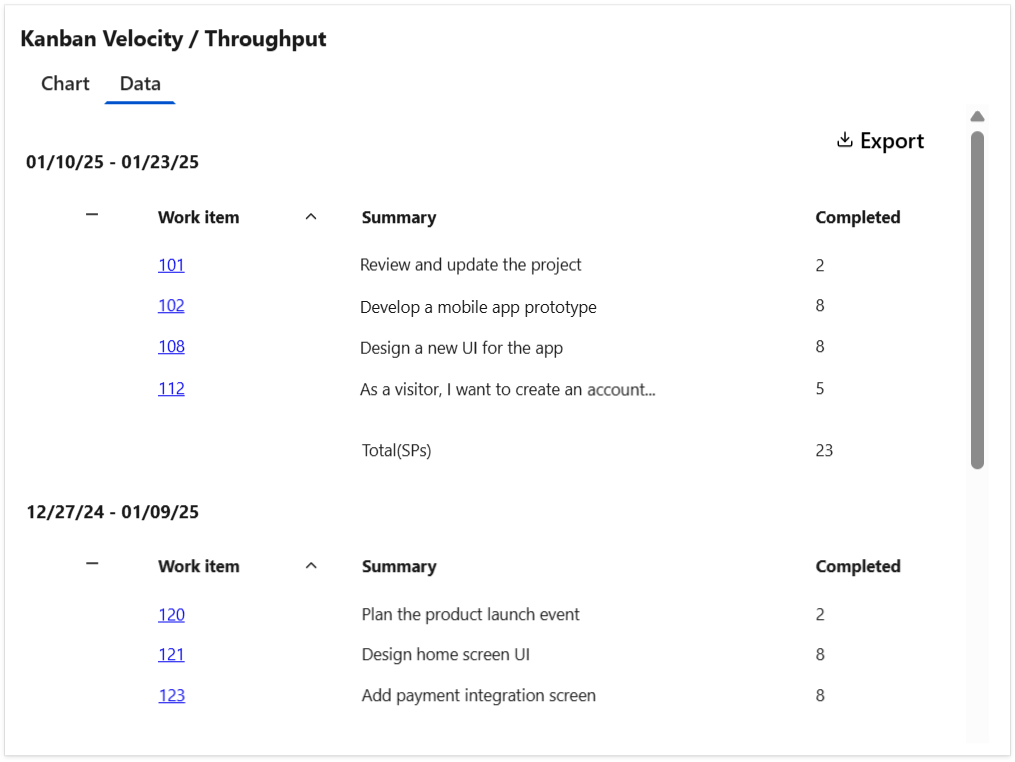
Optionally, the widget can display a Data tab with detailed information for each work item shown in each interval of the chart, which can be easily exported as a CSV file.
Configuration
The settings of this widget are divided in multiple tabs:
-
Data tab - contains the required settings of the widget, such as title or data source
-
More Settings tab - contains the optional settings
-
Colors tab - lets you customize the color of the lines displayed in the chart
Data tab
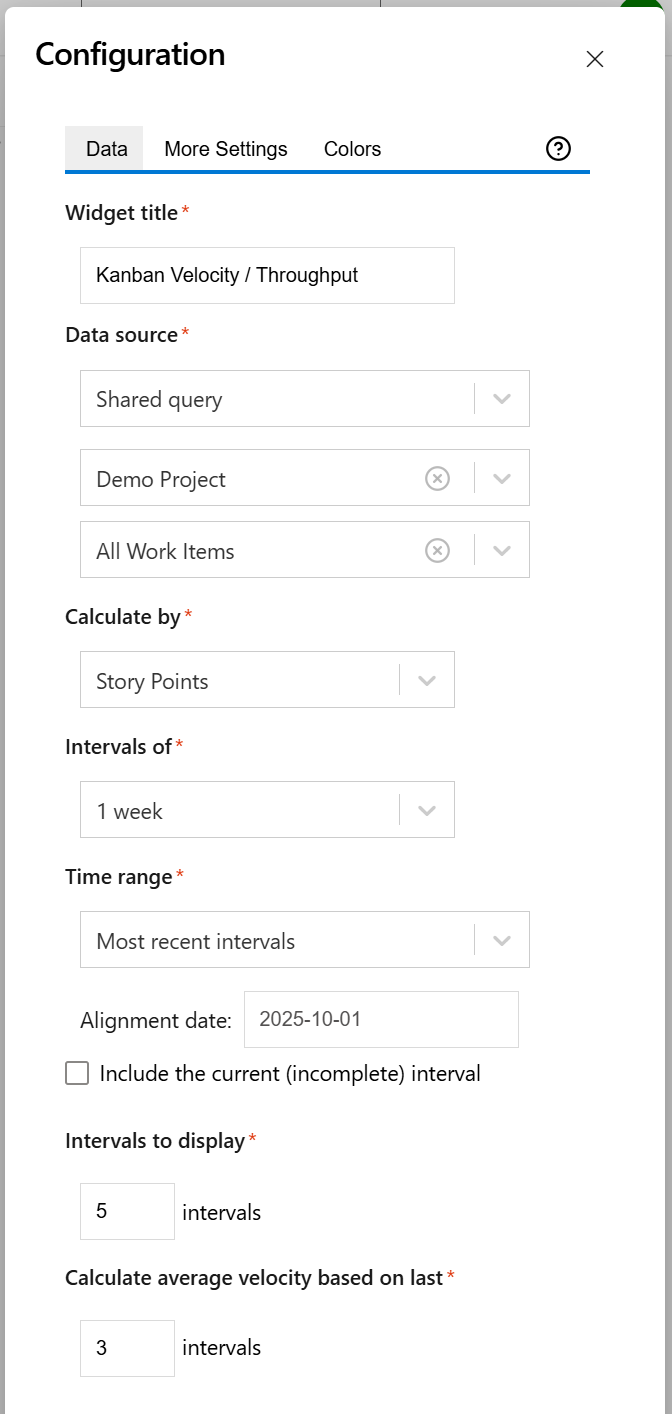
On this tab you can configure the required settings of the widget.
|
Setting |
Description |
|---|---|
|
Widget title |
Choose what to display in the title bar of the widget. |
|
Data source |
Select the type of Data Source used by the widget:
|
|
Calculate by |
Specify on which criteria the calculation is to be performed. You can choose between:
|
|
Intervals of |
Specify the duration for the time intervals used when calculating and displaying the velocity. If you do Agile development, this should be set according to the length of your sprints or iterations. |
|
Time range |
Select the time intervals to be displayed by the gadget. You can choose between:
|
|
Intervals to display |
Specify the number of previous completed time intervals to be displayed in the chart. |
|
Calculate average velocity based on last ? intervals |
Specify the number of time intervals to be used when calculating the average velocity. Velocity is calculated as the average of the total SPs done in each of these intervals. |
More Settings tab
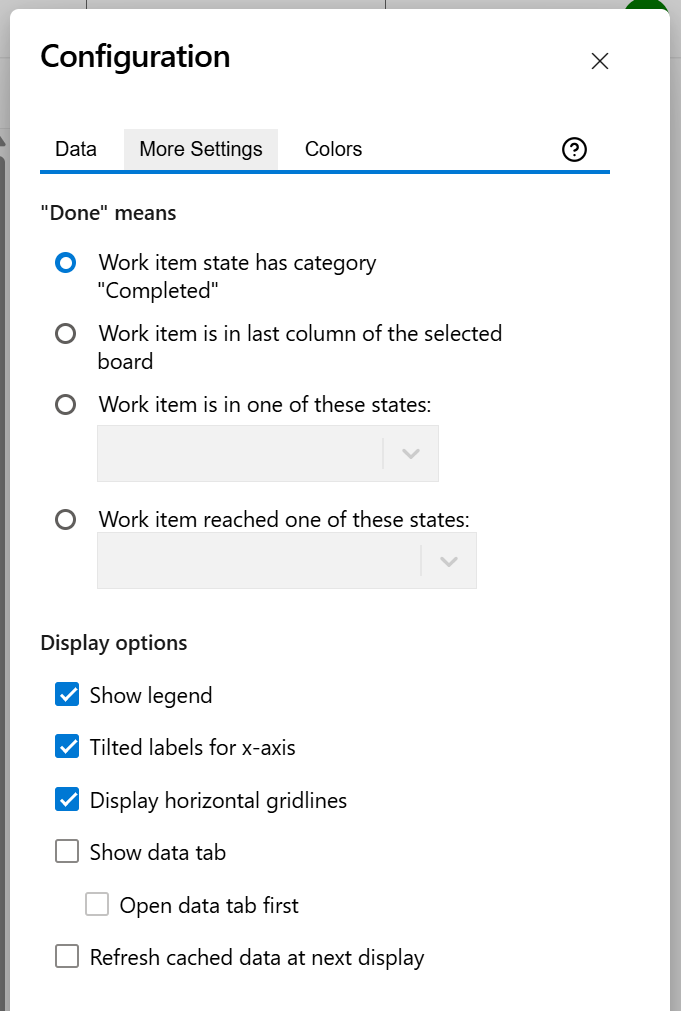
On this tab you can configure the optional settings of the widget.
|
Setting |
Description |
|---|---|
|
"Done" means |
Specify how the widget should consider items as done when determining the work completed. The default option is Work item has the category “Completed“, which means that the item is considered done if it has reached a “completed” category state (such as Resolved, Closed). Choose Work item is in last column of the selected board and select a board if you want to consider items as done when they reach the last column of the board or, more exactly, a state that is mapped to the last board column. Choose Work item is in one of these states, and then select one or more workflow states, to consider items as done when they reach one of these custom states. Choose Work item reached one of these states, and then select one or more workflow states, to consider as “done” those work items that reached one of the specified states at least once. |
|
Show legend |
Check this if you want the chart legend to be displayed. |
|
Tilted labels for x-axis |
Check this option to avoid overlapping labels on the x-axis. |
|
Display horizontal gridlines |
Check this option if you want the chart to display gridlines for the vertical axis. |
|
Show data tab |
Check this option if you want a data table to be displayed along with the chart. The Data tab displays all the time intervals with the items that affected their velocity. The items that had zeros on all the columns are not displayed. |
|
Open data tab first |
Check this option if you want the widget to open on the Data tab first (instead of Chart tab as default). Note that the tab order will remain unchanged (Chart, then Data); only the initial view will switch to the Data tab. |
|
Refresh cached data at next display |
This widget uses data caching for faster display, which means that some data resulted after processing are saved and reused next time the widget is loaded. If you check it, the cache of the widget will be deleted and recreated at the next reload. This setting is not persistent. |
Colors tab
On this tab you can customize the color of the lines displayed in the chart.
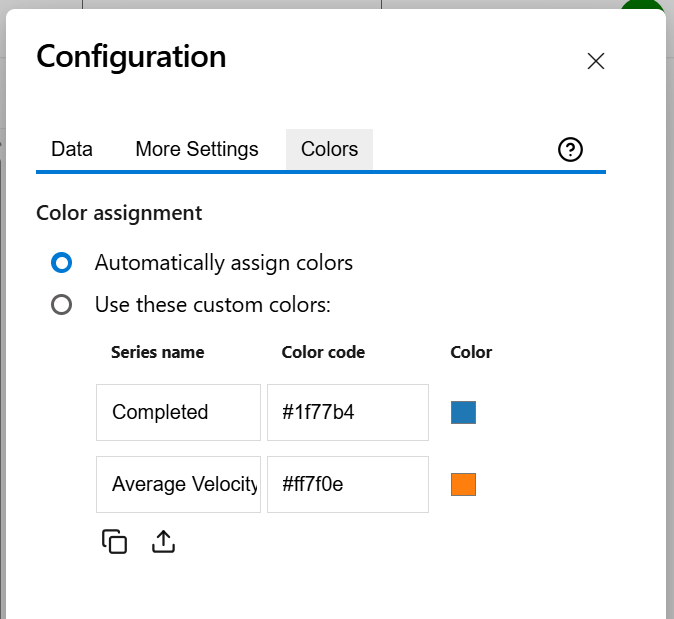
|
Setting |
Description |
|---|---|
|
Automatically assign colors |
Check this if you want the chart to automatically assign colors for the series. |
|
Custom colors |
Select any custom color you want the series to be displayed on by either entering the color's hexadecimal code or picking a color. You can also use the Copy and Import buttons to copy and import the color configuration to widgets of the same type. |